
Journal
21 Questions to Ask Your Wedding Photographer
Updated 16 October 2026
Your wedding photographer is the one vendor whose work you will still be looking at in thirty years. Yet many couples book on the strength of an Instagram feed and a quote sent over WhatsApp.
This guide is written for Indian weddings, where you are not booking one ceremony but five or six functions across two or three days — haldi, mehndi, sangeet, baraat, pheras and reception — often at a venue with its own rules. These are the 21 questions we would ask in your place, after more than eleven years of photographing weddings in Jaipur and across Rajasthan. Take them to every photographer on your shortlist, including us.
In this guide
- Before you call anyone
- Style and portfolio (questions 1–3)
- The team on your wedding day (4–9)
- What you will receive (10–15)
- Keeping your photos safe (16–17)
- Price, payments and the contract (18–21)
- Red flags to watch for
- How Tale Weaver answers these
- Frequently asked questions
Before you call anyone
A little homework makes the first call far more useful:
- Check the date is free. In Jaipur’s peak season (October to February), good teams are booked on popular muhurat dates months ahead.
- Look at complete galleries, not just the Instagram grid.
- Read Google reviews sorted by Newest. Recent reviews tell you how the team works today.
- Know your basics: the functions, rough guest count, venue and city.
Style and portfolio
1. How would you describe your photography style?
Photographers describe themselves as candid, traditional, cinematic, fine-art, or a mix. At an Indian wedding, two matter most:
- Traditional: posed family groups, stage photos with every relative, and each ritual covered in order. This is what your parents will ask for.
- Candid: unposed emotion — your father’s face at the vidaai, friends dancing at the sangeet, the moment the varmala goes on.
Most weddings need both. Ask whether the same team covers both, and how they balance them when the family wants forty group photos and you want golden-hour portraits at the same time.
2. Can we see two or three complete weddings, not just highlights?
Any photographer can pick twenty great frames from a thousand. A full gallery shows consistency: a daylight haldi, a stage-lit sangeet and pheras that ended at 2 a.m. Ask for weddings similar to yours in size and venue type. If they make films, watch a full highlight film, not just a 30-second reel. You can see complete weddings on our Work page.
3. Have you shot at our venue, or one like it?
Venue experience matters more than most couples realise. Jaipur’s palace hotels and havelis have harsh midday light in open courtyards, dark corridors, mirror-work rooms that bounce flash, and sometimes strict rules on lighting and drones. A team that knows the venue already knows where the light is good at 5 p.m. and where the family photos should happen. If they haven’t shot there, ask whether they will visit beforehand.
The team on your wedding day
4. Who exactly will photograph our wedding?
Many studios send associate photographers rather than the person whose work you saw. That isn’t necessarily bad, but you should know. Ask for the names of the lead photographer and cinematographer, look at their own work, and get those names written into the contract.
5. How many photographers and cinematographers will cover each function?
Crew size should match each function, not be one number for the whole wedding. A typical crew for a 200–300 guest wedding:
| Function | Typical crew |
|---|---|
| Haldi, mehndi | 1 candid photographer, 1 cinematographer |
| Sangeet | 1 candid, 1 traditional, 1–2 cinematographers |
| Baraat, varmala, pheras | 1 candid, 1 traditional, 2 cinematographers, plus drone if permitted |
| Reception | 1 candid, 1 traditional, 1 cinematographer |
Larger weddings need more. Ask who covers the bride and groom when they are getting ready at the same time in different parts of the venue.
6. Which functions and hours are covered — and what if the pheras run late?
Get the list of functions and the hours for each in writing. Pheras muhurats often fall late at night, and receptions rarely end on time. Ask for the overtime rate per hour, so a 1 a.m. muhurat doesn’t become a surprise bill.
7. How do you handle low light and night rituals?
Pheras around the sacred fire, candlelit sangeets and evening receptions are where weaker photographers struggle. Ask what they use — fast lenses, off-camera flash, video lights — and ask to see night photos from real weddings. Good low-light work keeps skin tones natural and the glow of the fire intact, without a flat, flashed look.
8. Do you shoot drone footage, and is it allowed at our venue?
Aerial shots of a baraat arriving at a palace are stunning, but drones in India are regulated. Ask:
- Is the drone registered on DGCA’s Digital Sky platform, and does the pilot hold a remote pilot certificate?
- Has the pilot checked the airspace zone for your venue? Areas near Jaipur airport can be restricted.
- Does your venue — or the authority that manages a heritage site — allow drones?
- What is the plan if the drone can’t fly because of wind, rain or permissions?
9. Do you handle both photo and video in-house?
Some studios outsource video to a separate team. That can mean two styles, two contacts and two delivery timelines. One in-house team plans shots together, stays out of each other’s frames, and gives you a single person to call.
What you will receive
10. How many edited photos will we receive?
“Unlimited photos” sounds generous but tells you nothing. Ask for an approximate number of fully edited photos per function, and what “edited” means — colour correction only, or retouching too.
11. What films are included, and how long is each?
Wedding films usually come in three forms: a teaser of about a minute for Instagram, a highlight film of a few minutes, and a full-length film of the rituals. Ask which you get, how long each runs, and how many rounds of changes are allowed.
Also ask about music. Films set to popular Bollywood songs are often muted or blocked on Instagram and YouTube for copyright. Ask whether they use licensed music, or can give you a version that is safe to post.
12. Will we get the raw files?
Raw files are every unedited frame from the wedding — often more than a terabyte for a multi-day event. They aren’t finished photos, but they are a complete record and a second backup. Ask whether raws are included, and bring your own hard drive.
13. How will we receive our photos, and how long will the gallery stay online?
A pen drive in a box is no longer enough. Ask whether you get a private online gallery that family abroad can open, how downloads work, and how long the gallery stays live.
Some studios now offer face-recognition galleries, where a guest uploads a selfie and sees only the photos they appear in. If yours does, ask how the selfies are stored and when they are deleted.
14. When will we receive everything?
Ask for a date for each deliverable. A good studio sends a few preview photos within a week. Fully edited photos often take 3–6 weeks, and films and albums take longer. Get these dates into the contract.
15. What album options do you offer?
Ask how many spreads the album has, what paper and cover it uses, who designs it, how many rounds of changes you get, and whether you approve a digital proof before printing. If your parents want copies, ask the price now.
Keeping your photos safe
16. What happens if a camera fails or someone falls ill?
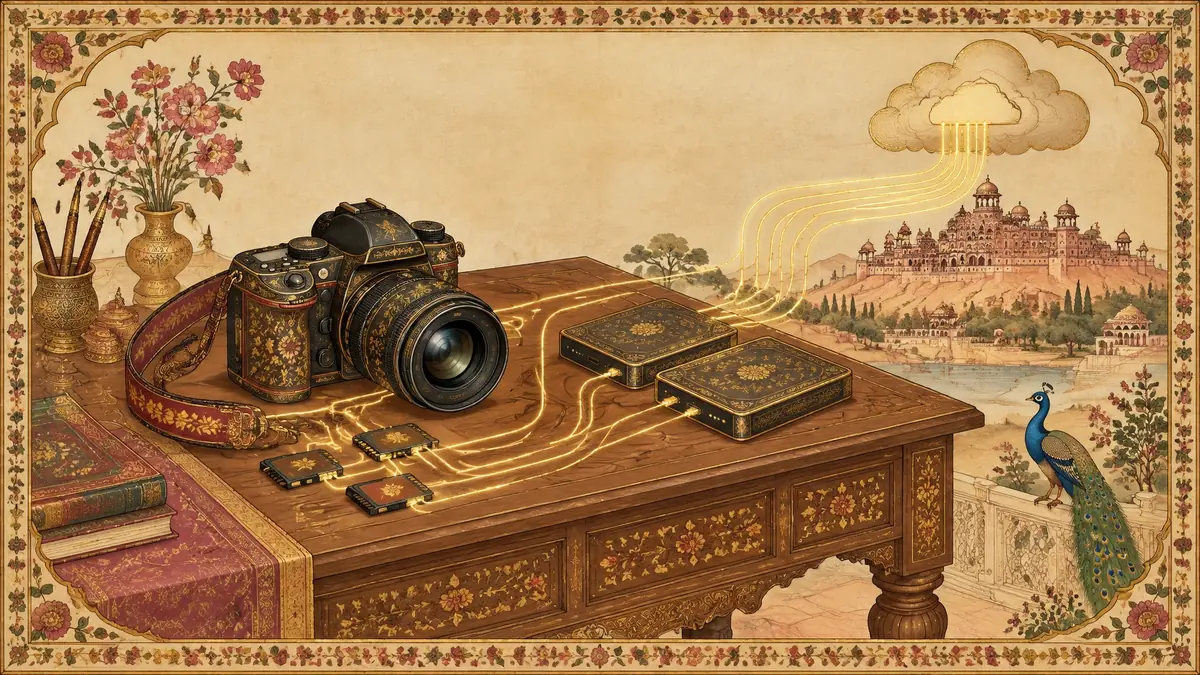
Professional cameras with dual memory-card slots record every photo twice as it is taken. Ask whether the team uses them, how many spare camera bodies come to the wedding, and who replaces a photographer who falls ill.
17. How do you back up our photos, and for how long do you keep them?
After the wedding, your photos should exist in at least three copies, on two kinds of storage, with one copy kept off-site — the 3-2-1 rule. Ask how they back up cards each night of a multi-day wedding, and how long they keep your files after delivery.
Price, payments and the contract
18. What exactly is included, and what costs extra?
Ask for an itemised quote. Common extras are travel, stay and meals for the crew at outstation venues, an extra function, overtime, drone coverage, album upgrades and extra copies. Ask whether the price includes GST. For help comparing quotes, read our guide on how to negotiate your wedding packages.
19. What is the payment schedule, and what if our date changes?
Most studios take an advance to block your date and the balance in stages. Ask how much is due and when, and what happens if the wedding is postponed or cancelled. Muhurats do move.
20. Will all of this be in a written contract?
A good contract lists:
- Date, venue, and each function with its hours
- Names of the lead photographer and cinematographer, and crew per function
- Deliverables with numbers and delivery dates
- Total price, GST and payment schedule
- Overtime, travel and stay terms
- Cancellation and postponement terms
- How your photos may be used
21. How will you use our photos?
Studios often share wedding work on Instagram and their website. Many couples love it; some families prefer privacy. Agree up front what can be shared, and whether you see it before anything is posted.
Red flags to watch for
- They can’t show a complete wedding gallery.
- They won’t say who will shoot your wedding.
- “Unlimited photos”, with no number anywhere.
- No written contract, or 100% payment up front.
- A price far below every other quote, with no explanation of what is missing.
- Recent reviews mention late delivery or lost files.
How Tale Weaver answers these
We would rather you ask us these questions than take our word for it. Here are our own answers:
- Who shoots your wedding: Abhinav Pardesi leads photography and cinematography, and Megha Kashyap leads post-production.
- Team size: at least 4–5 people at every function.
- Photo and video: one in-house team, trained together over the years, covers candid photography, traditional coverage and cinematic films.
- Delivery: everything except the album reaches you within 2 to 30 days. The album follows once you have selected your photos.
- Raw files: we hand over raw files for most weddings. Ask us before the shoot and we will confirm for yours.
- Backups: you receive a full copy of your data as your own backup, and we keep one backup while we work. We delete our copy once the project is complete, usually after 3 months.
See our services and complete weddings. Planning a pre-wedding shoot too? Read how to plan a pre-wedding shoot and our list of famous pre-wedding locations near Jaipur.
Frequently asked questions
How far in advance should we book a wedding photographer in Jaipur?
For weddings between October and February, book 6 to 12 months ahead. Popular muhurat dates fill first. Off-season dates can often be booked 2 to 3 months out.
How many photographers do we need for an Indian wedding?
For 200 to 300 guests, plan on at least one candid photographer, one traditional photographer and one or two cinematographers on the main day. Smaller functions like haldi usually need one photographer and one videographer.
What is the difference between candid and traditional wedding photography?
Traditional photography covers posed family groups, stage photos and every ritual in order. Candid photography captures unposed emotion and moments as they happen. Most Indian weddings need both.
Should we ask for the raw files from our wedding photographer?
Yes, if you want a complete record. Raw files are unedited and large, so bring a hard drive of at least 1 to 2 TB, and treat them as a backup, not as finished photos.
How long does wedding photo delivery take in India?
A good studio sends a few preview photos within a week. Fully edited photos usually take 3 to 6 weeks, and films and albums take longer. Get the dates written into your contract.